
Howard County Release Meanings
A Howard County release is the end of one custody event. It does not always mean the person walked into the community. The Howard County Department of Corrections, not the Sheriff’s Office, operates the Detention Center and Central Booking. Its custodial transaction is therefore the main record for admission, release, and destination after a county stay. Maryland court records can explain the legal order, while VINE may provide a faster status signal. Neither replaces the county transaction when an exact exit time or receiving authority matters.
Release on bond or recognizance normally ends physical custody while the case continues. Time served or sentence expiration ends the local custodial term, but probation or another case may still apply. Parole and mandatory supervision place a person in the community under conditions. Transfer is different: Howard County custody ends while Maryland DPSCS, another county, the U.S. Marshals Service, or immigration authorities take over. A dismissal, acquittal, or court order may authorize release, yet staff must still complete the discharge process and check for holds.
Howard County released inmates generally drop out of a present-custody view. That is why a missing name is not an answer. It may reflect release, transfer, escape, a search mismatch, or a system update. The useful question is both when the county stay ended and what happened next.
- Discharge
- The administrative end of a custody term or status.
- Time served
- Release when credited confinement satisfies the custodial term.
- Detainer
- A hold or request from another authority that may prevent community release.
- Mandatory supervision
- Conditional release before maximum expiration because applicable sentence credits have accrued.
Howard County Release Types
The release category directs the next search. A court docket can show a bail change, disposition, or sentence event, but it may not show the moment the person crossed the jail door. The county custody record should identify the release type and, when applicable, the destination. Use the exact wording supplied by Corrections because broad labels can hide a transfer.
| Release type | What it means | Next check |
|---|---|---|
| Bond or recognizance | Physical release while a case remains open | Howard court docket and county release transaction |
| Time served or expiration | The local custodial term has ended | Corrections record and any DPP supervision route |
| Parole or mandatory supervision | Community release under state conditions | DPP, MPC records, and VINE |
| Court-ordered release | A judge supplies legal authority to discharge | Court order plus physical release record |
| Transfer or detainer pickup | Another authority assumes custody | The named receiving agency’s locator or records office |
A probation disposition may follow custody, or it may be imposed without a prison term. Probation is court-ordered community supervision. Parole is conditional release from a sentence. Neither term should be used as a loose synonym for any former detainee. Howard County released inmate records should preserve those distinctions.
Howard County Release Record Fields
A focused release-record request should tie the person to one booking and ask for the transaction fields needed to distinguish release from transfer. The county does not promise that every field is public. Some material may be withheld or redacted under the Maryland Public Information Act. This inventory is a request checklist, not a claim that Howard County publishes a complete record online.
| Field | What it shows |
|---|---|
| Booking or admission number | Links the release to the correct county custody episode. |
| Admission date and time | Marks when the Howard County stay began. |
| Release date and time | Records the effective end of that custody event. |
| Release type or authority | Explains whether bond, sentence completion, or an order caused the exit. |
| Disposition or destination | Distinguishes community release from transfer to another authority. |
| Court or case number | Connects the transaction to the public legal record. |
| Facility and arresting agency | Identifies which office created each part of the record chain. |
Charge references, bond information, sentence dates, credit calculations, detainers, and property processing may also exist. Not all are releasable. A booking photograph can be requested with the same booking date and number, subject to public-record exceptions. The photo does not prove current custody or the release event.
Note: Ask for the destination field because “released” can mark transfer to another authority rather than a return to the community.
Request Howard County Release Records
The Howard County Public Information Act route accepts focused Corrections requests. Ask for an existing report, screen, log, or image rather than asking staff to create a narrative. Give enough detail to isolate the correct booking. The county’s researched route is piarecords@howardcountymd.gov or Department of County Administration, Attn: Patrick Pope, Assistant Chief Administrative Officer, 3430 Court House Drive, Ellicott City, MD 21043. Questions are listed at 410-313-4305.
- Supply the full legal name, known aliases, date of birth if lawfully known, and the approximate arrest or booking date.
- Ask for booking and admission identifiers, effective release date and time, release type, and destination or receiving authority.
- Add the related case number and booking photograph only when those records are needed.
- Request electronic delivery, allow redaction of exempt material, and ask for a cost estimate before charges exceed a chosen limit.
- If no record remains, ask which retention schedule, transfer, or lawful disposition accounts for its absence.
General Provisions §4-202 governs written applications and misdirected requests. Section §4-203 requires prompt action and generally sets a thirty-day outer limit. If production will exceed ten working days, the custodian must send an estimate of time and fees with the reason for delay. A denial must give the legal basis and review route, while any segregable, nonexempt part should still be released. Howard County guidance lists existing electronic copies without charge, black-and-white copies at twenty-five cents per page, and actual flash-drive cost for oversized files. Search or preparation time beyond the free statutory period may be charged. There is no verified single fixed price for one electronic Howard County release record, so request an estimate.
The successful county request-page capture shows the official submission route. Open the Howard County PIA page before reviewing the image.
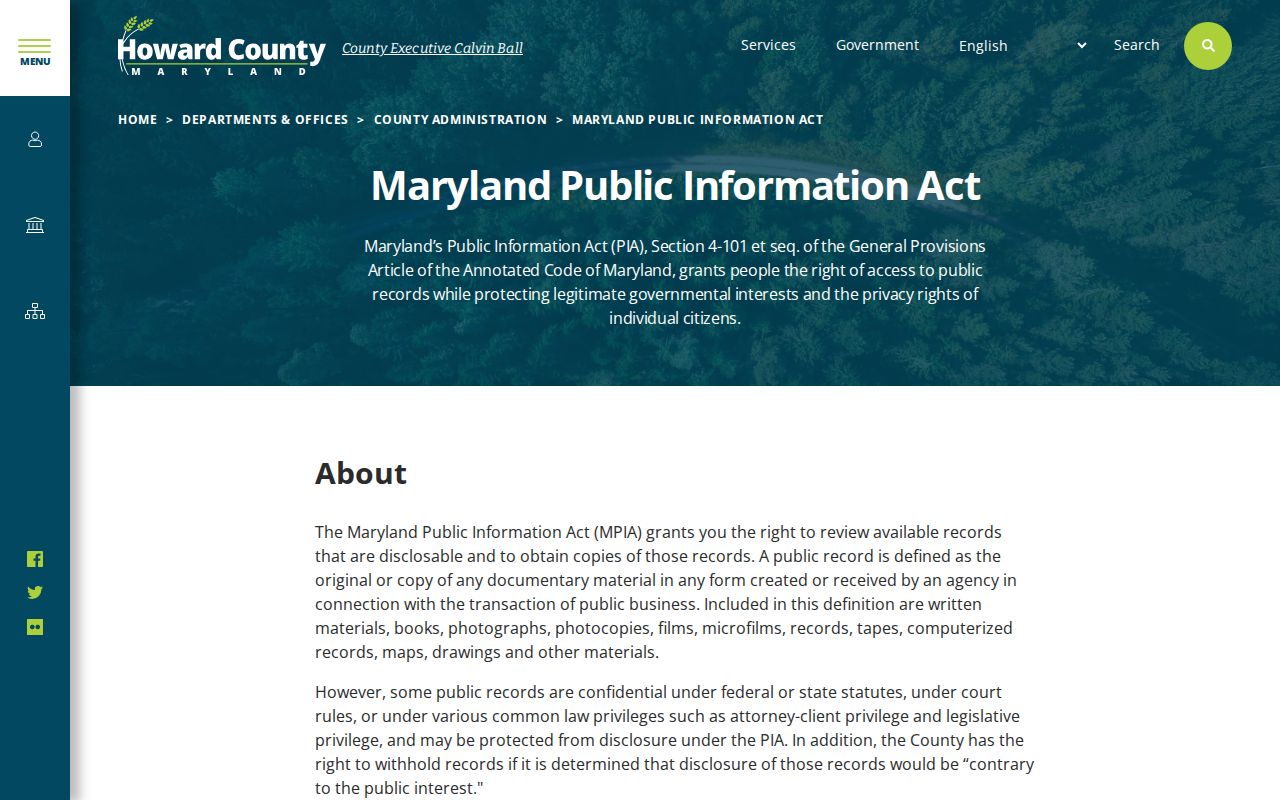
The page identifies the county channel that holds Corrections requests, not a commercial released-person search.
When Howard County Releases Occur
Howard County publishes unusually specific physical-release guidance. Most time-served discharges occur around 8:00 a.m. The Detention Center will not disclose a pending time-served date by telephone, so the individual must pass the schedule to family or another approved contact. That practice concerns pickup logistics. It is not an online release-list window and does not promise the same hour in every case.
Bond follows a separate paper path. The District Court Commissioner issues release papers after bond is posted, and those papers must reach the Detention Center’s Upper Control lobby window. Howard County estimates one to two hours after correct papers arrive. A court-ordered release can take longer because both the individual and all documents must return from court before discharge processing ends.
The successful capture below preserves the county’s official visitor and bond guidance.
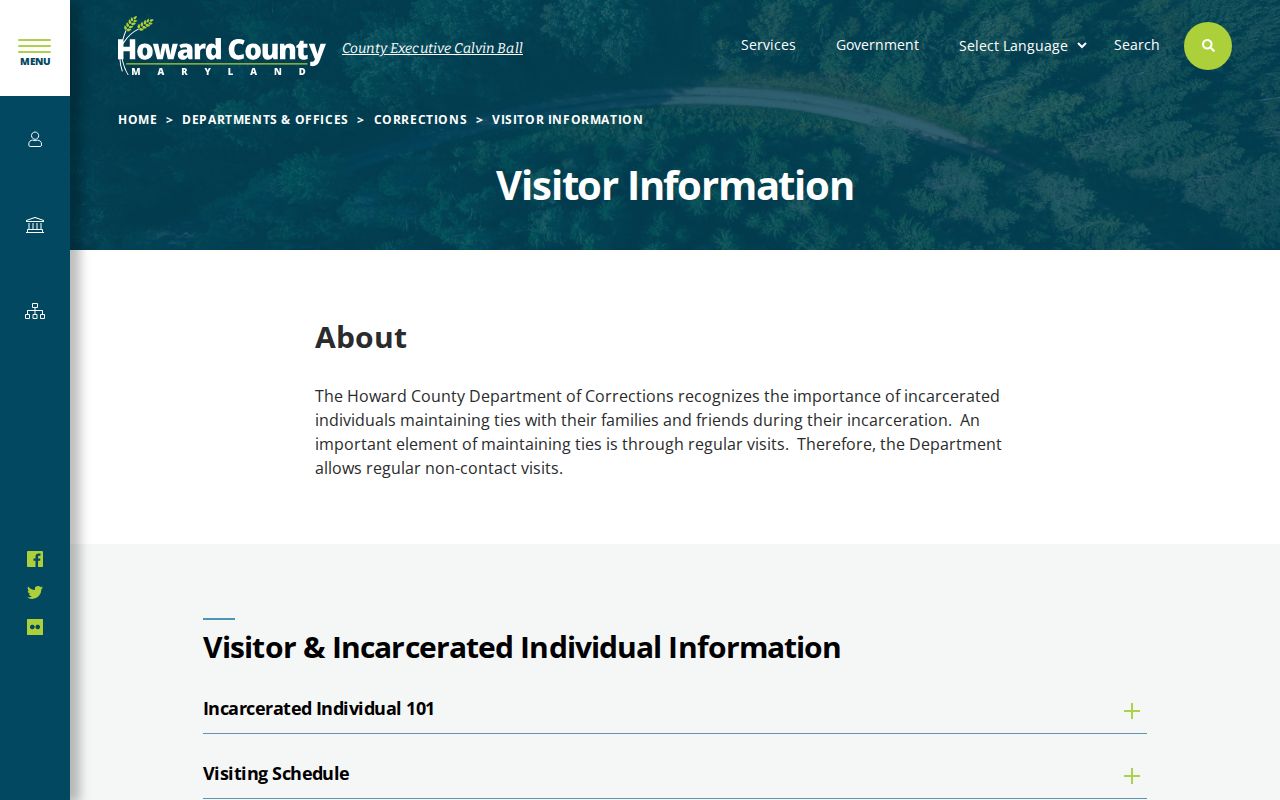
It shows why a courtroom order time and the physical release time can differ.
Find Howard County Released Inmates
Start with the last known custody type. Howard County does not publish a verified public jail roster or rolling recent-release feed. For a county arrest, the best chain combines the court docket, VINE, a current status call when needed, and a focused county request for the lasting transaction. The statewide DPSCS locator belongs later in the chain only when a record shows state transfer or commitment.
- Collect the full name, known date of birth, arrest date, arresting agency, and case or booking number.
- Search Maryland Judiciary Case Search by exact name or case number and narrow to Howard County.
- Read bail, commitment, disposition, sentence, and warrant entries as legal context, not as a door timestamp.
- Search Maryland VINELink for the person and compare agency, location, and identifiers.
- Ask Howard County Corrections for present status, then request the admission and release transaction when formal proof is needed.
- If the record says transferred, follow the named state, county, federal, or immigration authority.
For an older event, give greater weight to the court file and written custodial record. VINE is built for live status and notice. It is not a permanent certified archive. Names also require care. Compare middle names, dates, case numbers, and agency identifiers; do not rely on a photograph alone.
Howard County State Custody Search
The Maryland Department of Public Safety and Correctional Services calls its tool the Incarcerated Individual Locator. That title matters. The tool is for people currently in covered DPSCS custody, not a full archive of Howard County released inmates. A person booked and released only by Howard County may never appear. DPSCS also says people no longer in custody, including those released or escaped, are not listed.
| Search item | Use | Limit |
|---|---|---|
| First and last name | Find possible current DPSCS matches | Common names require added comparison |
| Displayed identifier | Separate one person from a namesake | Use only fields the live portal allows |
| Facility and status | Confirm the current state placement | A no-result is not a release record |
Use the locator after Howard County records, VINE, or a commitment entry shows transfer to state custody. If there is no match, check spelling and the custody system. Then ask Corrections or DPSCS for records instead of labeling the person released. The official explanation can be reviewed at the DPSCS locator information page.
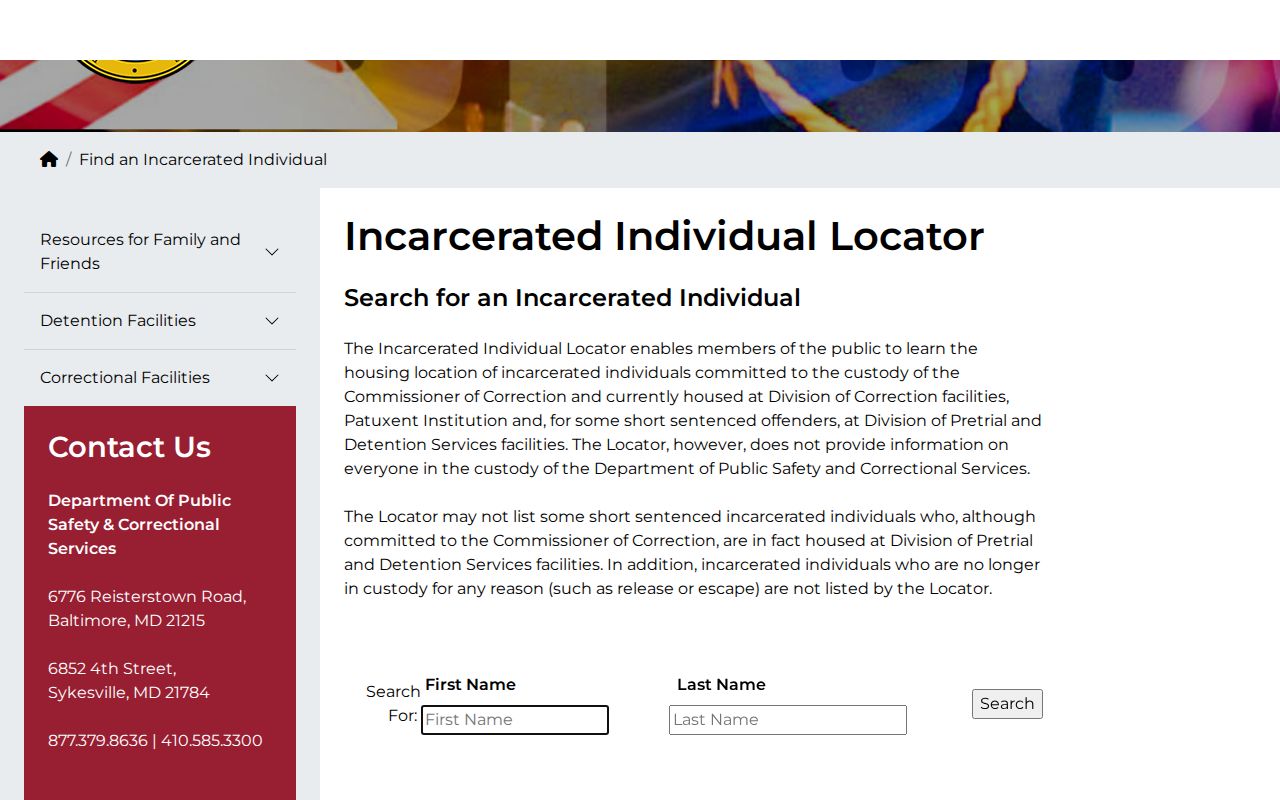
The image reinforces the key boundary: the state locator cannot replace a Howard County discharge record.
The Maryland Sex Offender Registry is a different, limited post-release channel. It applies only when a person has an active legal duty to register. A result can show registry information allowed by law, but the registry is not a general Howard County release list. No result says nothing about whether a person was booked, released, transferred, or placed under another form of supervision.
Note: A county-only booking may never enter DPSCS custody, even when the person spent time at the Howard County Detention Center.
Howard County Release Record Chain
Central Booking accepts arrestees from several agencies, including Howard County Police, Natural Resources Police, Maryland State Police, and Maryland Transportation Authority Police. One release search can therefore involve three custodians. The arresting agency may hold the incident report. Howard County Corrections holds the booking and release transaction. The District or Circuit Court holds the legal case file.
Keep those records in their lanes. An incident report describes the law-enforcement event. It does not prove the jail exit. A court disposition supplies legal context but may precede physical discharge or coexist with another hold. The county transaction should show when Howard County custody ended and whether another authority received the person. The Maryland State Archives account of Howard public safety confirms both the Corrections operator and the multi-agency intake function.
Question: Why can a court case exist when no Howard County custody result appears? A short booking episode may have ended, or the person may have moved from Central Booking to another authority. The docket and custodial transaction answer different parts of that sequence.
Note: Use the case and booking numbers to connect agency records; a shared name alone may join unrelated Howard County events.
Howard County Release Programs
Howard County Corrections documents pretrial programs, work release, home detention, treatment, mediation, and reentry work. These programs must not be confused with state post-release supervision. A person may still be in a county-administered placement even when not housed in a jail cell. Parole, probation, and mandatory supervision are handled through Maryland’s parole and probation structure after the applicable legal release.
The county capital plan also includes modular reentry and training space. That shows a local effort extending beyond cell custody, but it does not change which office keeps the release transaction. Start with the Howard County Corrections programs description. Then use Maryland DPP or MPC only when the record names supervision. The distinction prevents a home-detention placement from being mislabeled as an unconditional community release.
When supervision applies, no universal public DPP name-search was verified. VINE can report some parole or probation changes, and the Division of Parole and Probation office route may confirm or route a case where disclosure is allowed. The Maryland Parole Commission is the decision maker for qualifying parole cases, not the keeper of the county’s physical exit transaction. A person’s private reporting plan should not be requested or published.
Howard County ICE Transfers
Howard County’s history of immigration-detention policy makes the phrase “release to ICE” especially important. It means the county stay ended through transfer to federal immigration custody, not that the person entered the community. Check the exact destination in the county transaction. Then use the ICE Online Detainee Locator System or the responsible Enforcement and Removal Operations field office.
ODLS is mainly a current-detention tool. It can be searched with an A-number and country of birth, or name, date of birth, and country of birth. Missing results are not conclusive because the system has timing and disclosure limits. Proposed, disputed, or private sites should not be treated as operating Howard County facilities without official confirmation. The county facility map contains no verified operating ICE detention center.
Federal criminal custody follows another route. The BOP Inmate Locator covers federal records from 1982 forward and may show a release date. “Not in BOP custody” only ends the BOP part of the chain. U.S. Marshals custody requires a federal docket, district contact, or records request because USMS does not provide a comparable public historic locator.
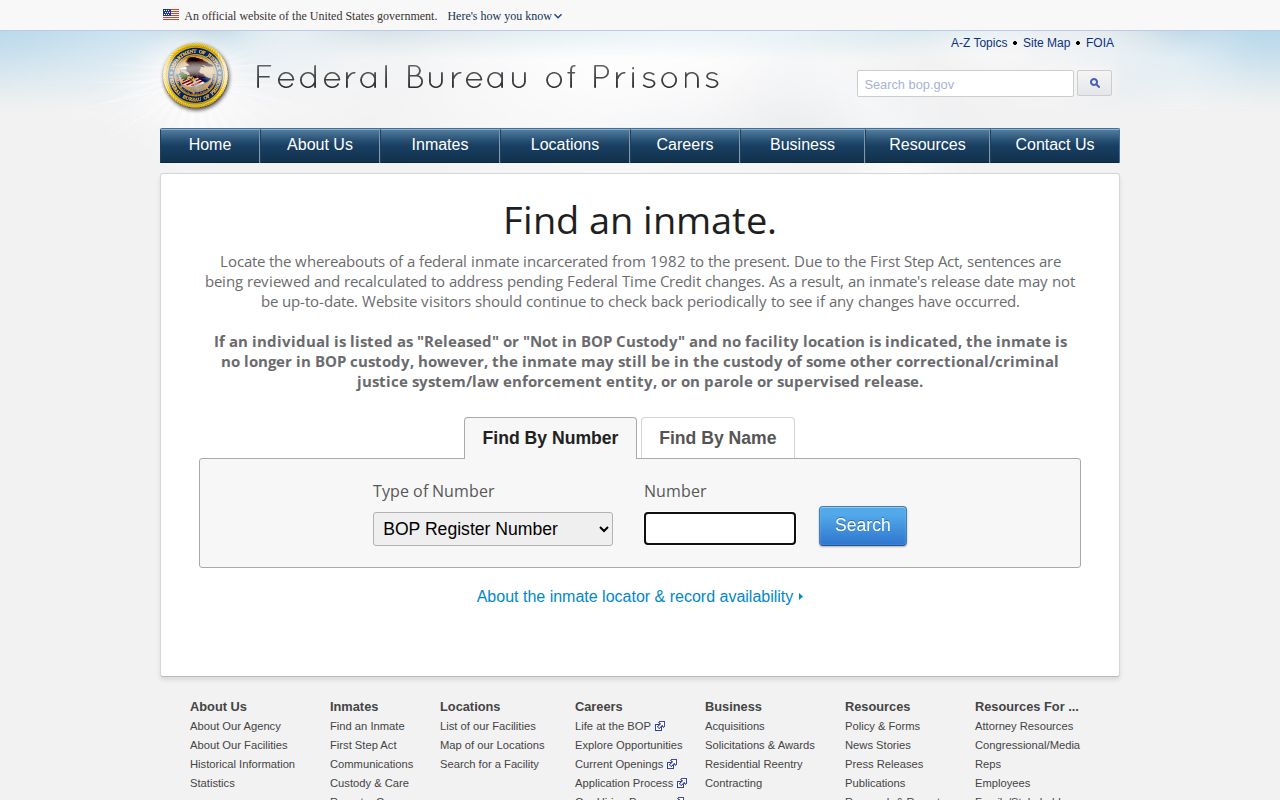
The BOP capture is relevant only after the Howard County record identifies a federal connection.
Howard County Release Visibility
Maryland Judiciary Case Search is a public summary, not the complete courthouse file. Public visibility can change after expungement, shielding, sealing, and certain non-conviction outcomes. Juvenile and other protected records may also be unavailable. In Howard County, where no official recent-release archive was verified, saving lawful personal paperwork and requesting the official custodial transaction promptly can preserve the clearest proof.
An absent result years later does not show that an arrest or release never happened. Ask the responsible clerk whether a public file is available and ask Corrections whether the requested transaction still exists. If it does not, request the applicable retention schedule or archive route. The Maryland court-record access explanation details why the online summary can differ from the courthouse record.
- Is the person in Howard custody now?
- Use the Howard County Corrections status channel, while remembering that present status is not a historic report.
- When did the county stay end?
- Request the Howard County custodial transaction and include the release type and destination.
- What legal event occurred?
- Use Case Search or the court file, but do not treat a docket entry as the physical exit time.
- Did state custody follow?
- Check the DPSCS locator and records. No result does not prove release.
- Was a custody change reported?
- Check VINE, then use the agency record when certified proof matters.
Note: A later missing court summary can reflect lawful access limits, not proof that the Howard County custody event never occurred.
Howard County Release Facilities
The Howard County Detention Center is the principal adult detention facility at the Waterloo Road campus. It houses adults awaiting trial and locally sentenced people within the term described by the county budget. Its administration performs sentence computation and keeps county custodial records. A person may leave for the community, a county alternative, supervision, or another authority.
The Howard County Central Booking Facility is a booking and intake function at the same campus. A short episode can end after processing or initial judicial action, continue into Detention Center custody, or become a transfer. Ask for both booking/admission and disposition fields. There is no separate public release database for the building.
Note: Howard County Corrections, not the Sheriff’s Office, operates both listed county detention functions and maintains their release transactions.
Howard County Detention Renovations
The existing Detention Center remains the correct Howard County release-record and contact route during phased renovations. The county capital plan describes work involving control systems, alarms, the lobby, mental-health space, and a modular reentry and training building. It also anticipates preliminary planning for a long-term replacement. Those projects provide useful current context, but they do not announce a completed move or a new custodian for released inmate records.
Continue using the Waterloo Road Corrections channels unless Howard County formally changes them. A search for “Jessup” can return state institutions in the wider correctional region, including facilities outside Howard County. Match the agency and county, not just the place name. The FY2026 capital project description is the source for the renovation and planning details.