
Howard County VINE Coverage
Maryland VINE is status and notification infrastructure for participating agencies. State materials identify District Court, Circuit Court, detention centers, the Division of Correction, parole, and probation as covered categories. That range matters in Howard County because a case can pass from Central Booking to the Detention Center, a Maryland state facility, or community supervision. The matched record should still identify the agency actually supplying the event.
VINE has two distinct roles. Its search can display the current status or last reported event for one person. Registration sends notice when a covered event occurs. Neither function creates the county’s official admission or release transaction. Federal custody belongs to the Bureau of Prisons or another responsible federal agency. VINE also is not a permanent historic archive after a person’s active record changes.
- Custody status
- The exact condition reported by the agency.
- Release event
- A notice that custody ended under that record.
- Transfer
- Movement to another custodian, not community release.
- Notification
- An alert tied to the selected person and event.
Search Howard County VINE Records
Open the official Maryland VINELink search and use the offender or custody search. A name alone may return a namesake. Compare location, agency, and identifiers before treating the status as belonging to the intended person.
- Select Maryland and open the offender or custody search.
- Enter the full name and add the offender or ID number when available.
- Open each possible match and compare agency, location, and identifier.
- Read the exact status and most recent event.
- If the record says transfer, identify and check the receiving system.
- Request the county or DPSCS record when documentary proof is needed.
A county-only booking may never belong in the DPSCS locator. Someone transferred to state custody may leave a local record while remaining confined. The Howard County release-record search path explains how those sources fit together.
Note: A no-match can reflect spelling, timing, transfer, participation, or record limits and does not prove release.
Howard County VINE Result Fields
The live record controls the wording. Maryland VINE can report custody status, agency or location, an offender identifier, and an event such as release, transfer, or escape. Some records offer notification registration. Fields differ by participating agency, and a delayed feed can trail the physical event.
| Field | Use | Limit |
|---|---|---|
| Name and ID | Match person and case | Namesakes need care |
| Agency or location | Identify custodian | Changes after transfer |
| Status | Preserve exact phrase | Not a certified record |
| Last event | Separate release and transfer | May lag |
| Notification | Register for this record | Does not follow all systems |
“Released” means VINE received that status for the feeder record. It does not state the Howard County release type, destination, or door time. A transfer means one custody record ended because another authority took responsibility. Follow the new custodian.
The Maryland VINE interface provides the person search and record-specific notification path.
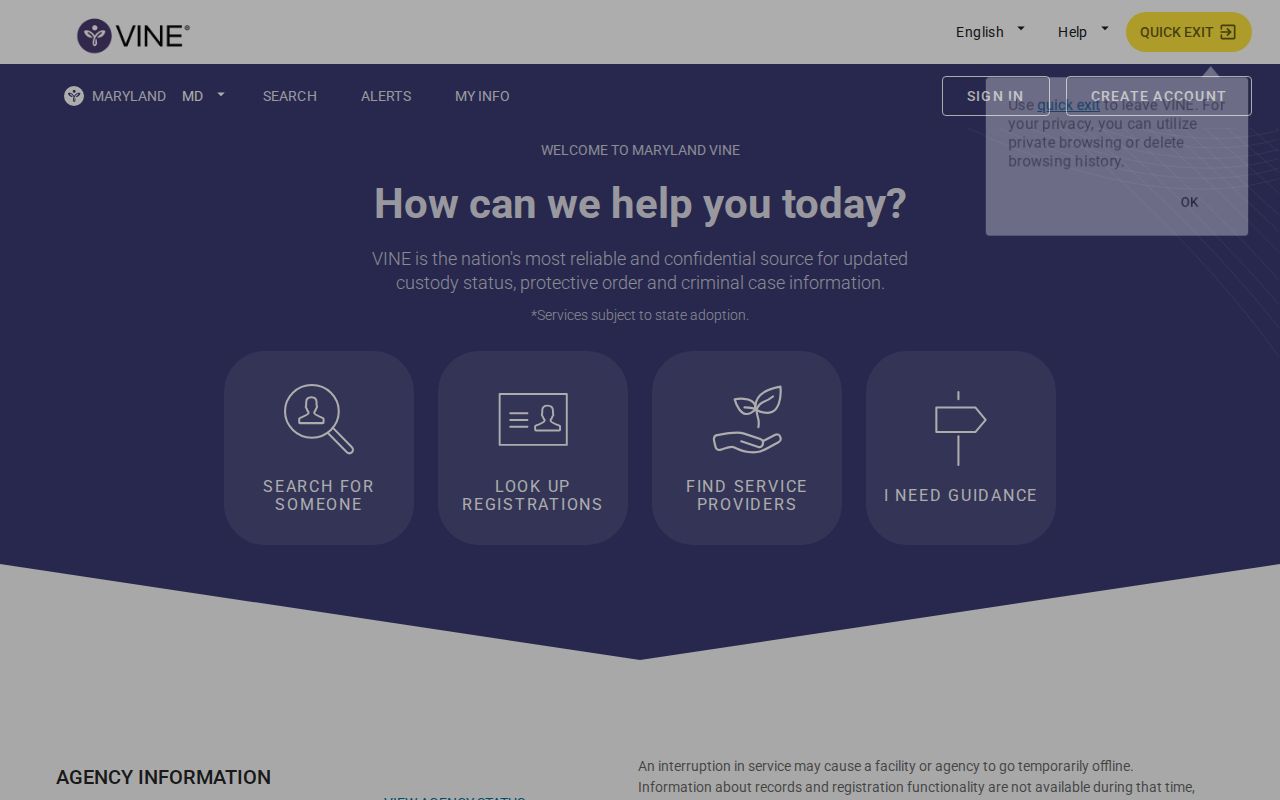
The captured interface shows the official channel to use while preserving the need to verify the matched agency and exact event.
Register Howard County Release Alerts
Registration is tied to the matched record. Maryland’s official brochure explains phone and email options. Phone alerts use an acknowledgment PIN; email alerts do not. Use contact details that can be monitored and update them after a change.
- Open the verified record and select notifications.
- Choose phone and/or email and enter the requested contact.
- For phone notice, create a four-digit PIN and keep it secure.
- When called, listen and enter the PIN followed by the pound key.
- Re-register after a court change, local-to-state transfer, or entry into supervision.
The Maryland VINE brochure says an unanswered call may produce repeat attempts until acknowledgment or the stated call period ends. Entering the PIN confirms receipt, not the event’s accuracy for every legal purpose.
Maryland VINE is also available at 1-866-634-8463. Service representatives are listed as available around the clock. That channel assists with registration and service use, not certification of a Howard County release.
Howard County VINE Release Limits
VINE depends on agency feeds. A release may be processed before the public status changes, and movement can require a new registration. Howard County has no verified official rolling release feed. VINE is an important fallback, but it does not become a county-issued list or archive.
A current-custody search and a release record answer different questions. Someone held at HCDC may appear locally. A person transferred to DPSCS remains confined even if the local record closes. DPSCS expressly drops people no longer in custody for reasons that include release or escape, so absence cannot be converted into release.
Court records supply legal context. A bail order, dismissal, sentence entry, or parole action can explain authority, yet discharge may occur later and another hold may remain. Pair Case Search with VINE and the custodial transaction. For BOP, ICE, or USMS movement, use the receiving federal channel.
Timing also affects interpretation. The court may issue an order before the person and papers return to HCDC, and Corrections still must complete discharge processing. A VINE notice can arrive near that chain without supplying the legal order or the exact physical exit time. If the question concerns a same-day event, contact the responsible agency for status. If lasting proof is needed, request the admission and release transaction with the disposition and destination.
Older events require a different method. VINELink is built for current status and alerts, not permanent certified history. Maryland Case Search can preserve public legal context after a short stay, while the county custodial record documents the physical event. Sealed, shielded, expunged, juvenile, and other protected matters may be unavailable. A later blank search is not evidence that the person was never booked or released.
Note: The Maryland registry applies only to people with a registration duty and is never a general release lookup.
Howard County Release Notification Chain
Howard County adds a local quality-control layer. HCDC policy A-020 assigns a corporal or sergeant on the midnight shift to audit VINE at least weekly for accurate HCDC listings. The policy also describes a separate requested victim or witness notification process for release, escape, recapture, death, and certain release conditions. That internal process is not public VINELink registration.
The local rule is continuity. Maryland requires new registration when a case moves between District and Circuit Court, when a person transfers from local detention to state prison, or when the person enters parole or probation. HCDC policy treats transfer separately from release. A Howard County alert cannot be assumed to follow every later agency.
The HCDC notification policy is the county source. If an alert concerns safety, follow the brochure’s warning not to rely on VINE alone. For record accuracy, obtain the release or transfer transaction from the responsible agency.
A sound chain is local registration, new registration after state transfer, and a fresh registration if supervision begins. Keep the exact agency and event with each notice. That preserves the record sequence without treating several alerts as one certified document.
Howard County Central Booking receives people arrested by several agencies. The arresting agency may hold an incident report, Corrections holds the booking and custody transaction, and a District or Circuit Court holds the case record. VINE links to the custody event but does not merge those separate files. When names or dates differ, compare the case and booking identifiers and ask the originating office to correct its own record.
Confirm Howard County VINE Events
A release notice should be compared with the Howard County custodial record when the exact time, legal authority, or destination matters. Ask Corrections for the existing admission and release transaction. Useful fields include booking number, admission time, releasing authority, effective release time, release type, destination, and related case number. Some fields may be redacted or withheld under Maryland law.
Case Search can explain the public court event that led to discharge, but a docket entry is not the physical exit record. A dismissal, bail change, time-served disposition, or sentence entry may precede final processing. Another warrant or detainer can also continue custody. The county transaction and receiving-agency record resolve that gap.
If VINE reports a transfer, keep the alert and register under the receiving system. For a Maryland commitment, check DPSCS. For a federal sentence, use BOP. For immigration custody, use ICE’s current detainee channel. A Howard County event ends only the county segment of the custody chain.
Match Howard County VINE Identities
Identity matching is essential before registration. Common names, aliases, spelling differences, and reused names can produce the wrong record. Compare the full name, middle name, offender or booking number, agency, location, and date of birth when that information is lawfully displayed. A photograph or name alone is not enough.
Howard County Central Booking processes people delivered by several law-enforcement agencies. The arresting agency name may therefore differ from the custody agency shown in VINE. That difference is not automatically an error. Corrections can hold the booking record while a police agency holds the incident report and a Maryland court holds the case.
If two possible records remain, do not register based on a guess. Check the Howard County case number, approximate arrest date, and known facility. Then compare the VINE identifier with the custody paperwork or ask the responsible agency for permitted confirmation. Register only after the person and agency align.
Preserve the exact record label when reporting an event. “Released,” “transfer,” and “escape” have different meanings. A release can still lead to supervision, while a transfer means custody continues elsewhere. Careful identity and status matching keeps a prompt alert from becoming an unsupported claim.
Note: Re-register after a transfer because one Howard County VINE registration does not automatically follow every later custody or supervision record.